
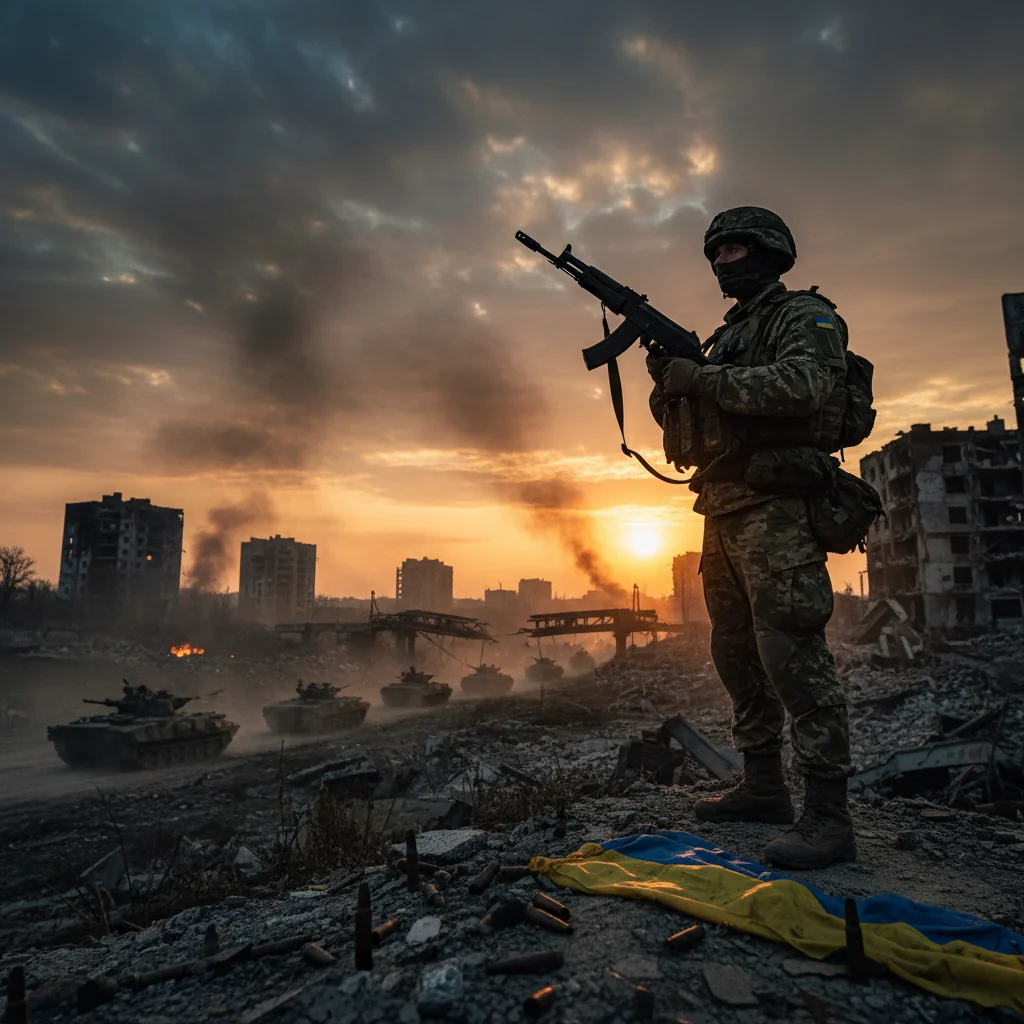
Key Events in the Russia-Ukraine War: Day 1,380
As the Russia-Ukraine conflict reaches its 1,380th day on December 5, 2025, several significant developments have unfolded across military, diplomatic, and economic spheres.
Escalation in Southern Ukraine
Overnight Russian attacks have severely impacted southern Ukraine’s infrastructure. In the Odesa region, approximately 51,800 households lost electricity after a key facility was struck. Similarly, in Kherson, a major heat and power plant was forced to shut down, leaving 40,500 residents without heating. The governor of Kherson condemned these attacks, highlighting the extensive damage to civilian infrastructure.
Putin’s Stance on Donbas
Russian President Vladimir Putin has reiterated Russia’s intent to gain full control over Ukraine’s Donbas region, comprising Donetsk and Luhansk. He stated that this objective would be achieved either militarily or through the withdrawal of Ukrainian forces. Ukraine has firmly rejected this ultimatum, emphasizing that Russia should not be rewarded for its aggression.
Putin’s Visit to India
President Putin arrived in New Delhi for summit talks with Indian Prime Minister Narendra Modi. The visit aims to strengthen economic and defense ties between Russia and India. Discussions are expected to cover defense cooperation, trade, labor mobility, and civil nuclear energy, with several agreements anticipated.
Impact on Global Oil Markets
Oil prices have edged higher following Ukrainian strikes on Russian oil infrastructure and stalled peace talks between the U.S. and Russia. Ukraine targeted the Druzhba pipeline in Russia’s Tambov region, marking the fifth such attack. Despite this, pipeline operators reported normal flow. Analysts noted that Ukraine’s sustained drone strikes on Russian refineries have strategically aimed at disrupting production, resulting in a reduction of 335,000 barrels per day in refining throughput between September and November.
Turkey’s Call for Energy Infrastructure Protection
In response to recent attacks on tankers near Turkey’s Black Sea coast, Turkish Energy Minister Alparslan Bayraktar urged Russia, Ukraine, and other involved parties to keep energy infrastructure out of the conflict and maintain uninterrupted energy flows. Turkey condemned these attacks and raised concerns at a NATO meeting, warning against targeting energy routes crucial for Kazakhstan’s oil exports.
These developments underscore the ongoing volatility and complexity of the Russia-Ukraine conflict, with significant implications for regional stability and global markets.


