Lenskart’s Stock Market Debut: A Mixed Reception Amid High Valuation Concerns
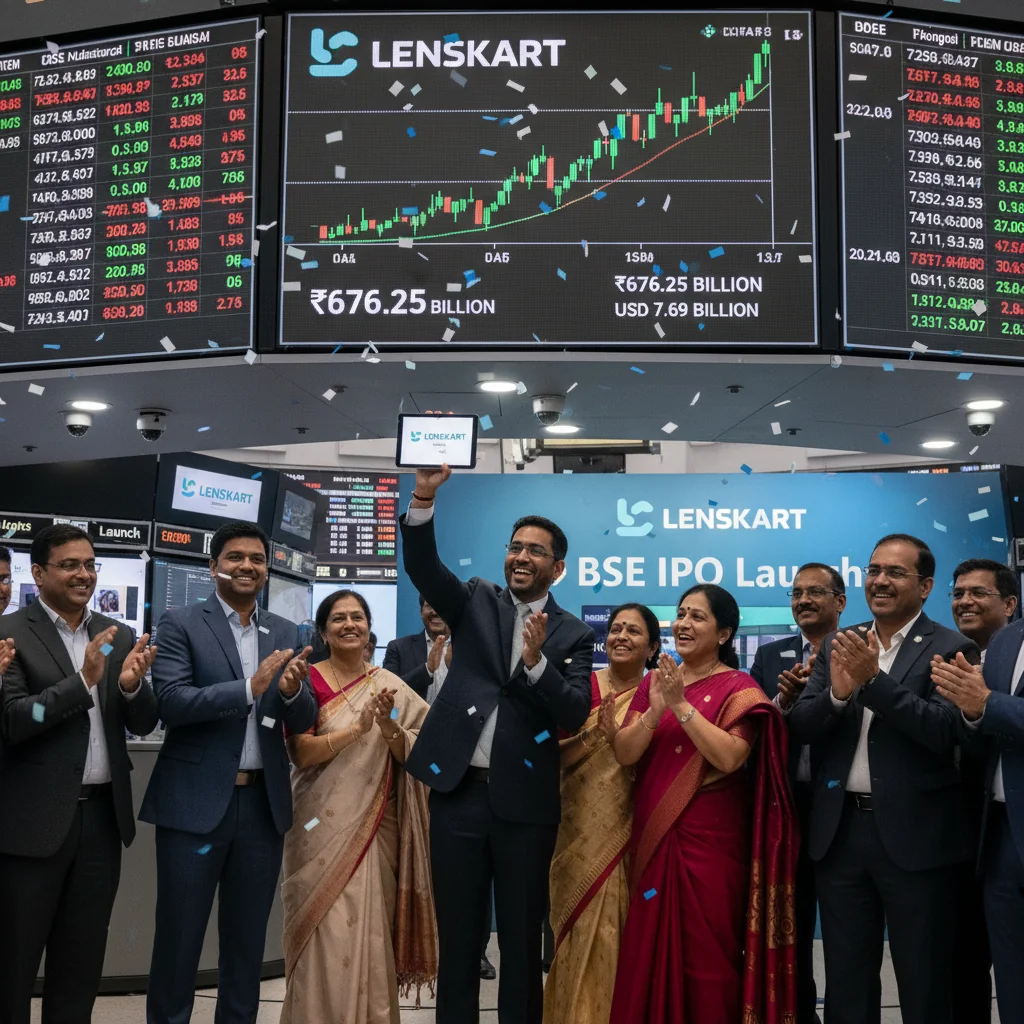
On November 10, 2025, Lenskart Solutions, India’s leading eyewear retailer, commenced trading on the stock market with a valuation of ₹676.25 billion ($7.69 billion). The initial public offering (IPO) was priced at ₹402 per share; however, the stock experienced an 11% decline, reaching a low of ₹356.1 before recovering to ₹392.3 by mid-morning. This performance places Lenskart’s valuation significantly below that of its competitor, Titan, which stands at $37.7 billion.
Investor Enthusiasm Meets Market Realities
The IPO, valued at $828 million, garnered substantial interest, with total bids exceeding $13 billion. Despite this enthusiasm, market analysts have expressed concerns regarding Lenskart’s high valuation. Independent market analyst Ambareesh Baliga highlighted the importance of evaluating company fundamentals over grey market premiums, which had peaked at ₹108 prior to the IPO.
Financial Performance and Growth Strategy
In the fiscal year 2025, Lenskart reported a 23% increase in revenue, totaling ₹66.53 billion, and achieved profitability. The IPO comprised a fresh issue of ₹21.5 billion and an offer for sale amounting to ₹51.3 billion. The company plans to utilize the proceeds to expand its retail footprint, including the addition of 450 new stores within the current financial year, aiming to surpass 3,150 stores across 14 countries.
Technological Innovations and Future Outlook
Under the leadership of CEO Peyush Bansal, Lenskart is investing in artificial intelligence (AI) to enhance customer experiences. The company has introduced AI-driven eye tests in international markets and is scaling remote eye testing services across India. Additionally, Lenskart has invested in Ajna Lens, a Mumbai-based deep-tech firm specializing in AI-powered extended reality (XR) glasses, signaling a commitment to innovation in the eyewear sector.
As Lenskart navigates its post-IPO phase, the company faces the challenge of aligning its ambitious growth plans and technological advancements with investor expectations and market dynamics.