
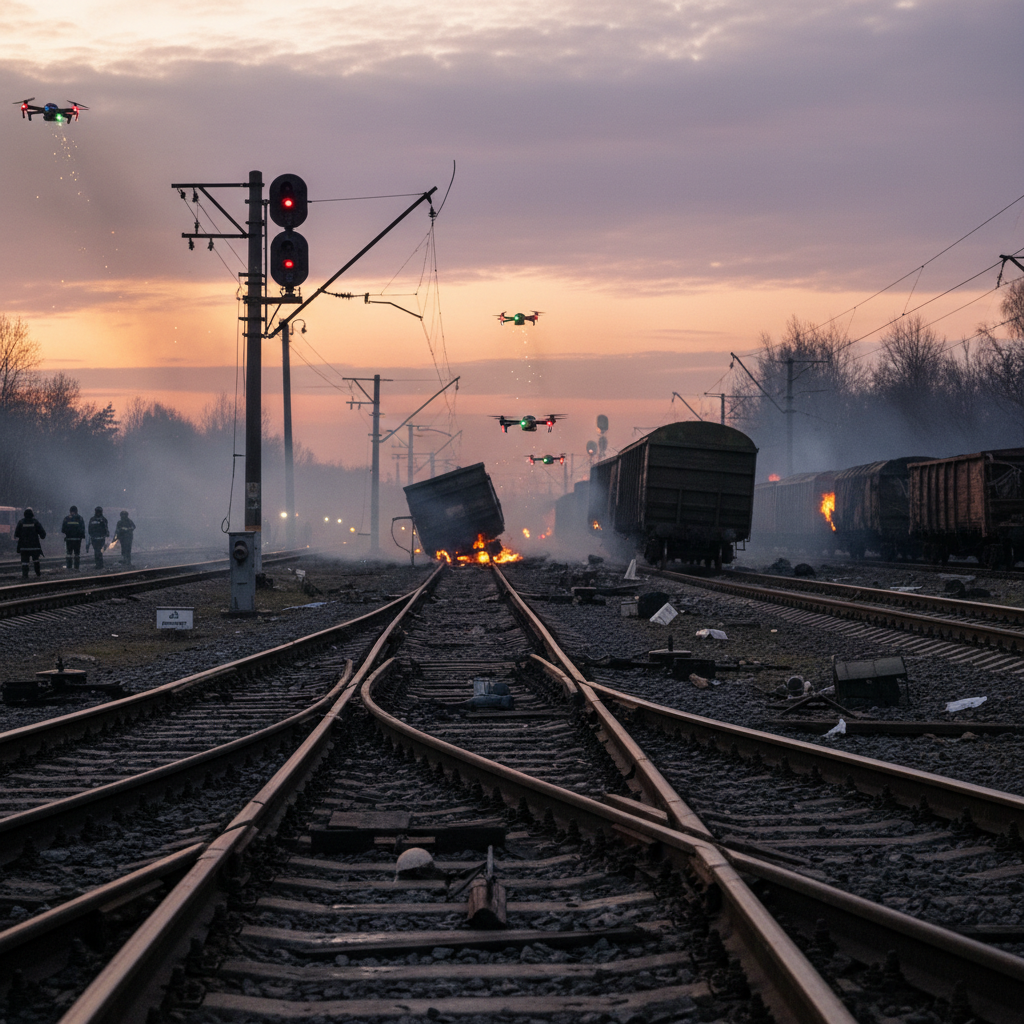
Russia has significantly escalated drone attacks on Ukraine’s railway infrastructure since mid-summer 2025, using newly upgraded precision-guided drones equipped with onboard cameras to target locomotives and rail stations with unprecedented accuracy[1]. The intensified campaign threatens Ukraine’s critical transportation artery that carries more than 63% of the country’s freight and 37% of passenger traffic[1].
In one of the most recent attacks, Russian drones struck the Shostka train station in northeastern Ukraine earlier this month, killing a 71-year-old man and injuring at least eight people. Two explosives-laden drones hit commuter trains in quick succession, leaving train cars buckled by fire and riddled with shrapnel holes[1]. The station is located less than 43 miles from the Russian border[1].
Ukrainian railway CEO Oleksandr Pertsovskyi told the Associated Press that the frequency of attacks has more than doubled since mid-summer, increasing from approximately one attack per week to two or three per week[1]. However, Deputy Prime Minister Oleksii Kuleba revealed the actual scale is far greater, with 300 attacks on railway infrastructure occurring since August alone—representing about 10 attacks per week[1].
The surge in effectiveness stems from technological advances in Russia’s drone fleet. Since summer 2025, Russian forces have fitted long-range strike drones, including the Iranian-designed Shahed and its Russian variant Geran, with cameras and radio modems that transmit live video feeds back to operators[1]. This upgrade allows real-time flight path adjustments, dramatically increasing precision compared to preprogrammed models.
“Now, as they have very precise Shahed drones, they are targeting individual locomotives,” Pertsovskyi explained[1]. Ukrainian military drone expert Serhii Beskrestnov warned that locomotives are particularly vulnerable because they are slow-moving and follow predictable routes. “If the Russians keep hitting diesel and electric locomotives, the time will come very soon when the track will still be intact—but we’ll have nothing left to run on it,” he said[1].
The modified drones can fly up to 124 miles into Ukrainian territory while streaming video back to operators in Russian-held areas[1]. Ukrainian Defense Ministry officials who examined recovered Geran-type drones confirmed the cameras also allow Russian operators to identify Ukrainian air defense systems and assess ground damage[1].
Ukraine’s rail network serves as an essential lifeline not only for commercial freight and passenger traffic but also for moving grain and metal exports to seaports and transporting military aid from allied nations[1]. Railway officials have maintained operations despite repeated strikes through speedy repairs, but experts warn that the growing tempo and precision of attacks pose an increasingly serious threat to Ukraine’s logistical capabilities.


