
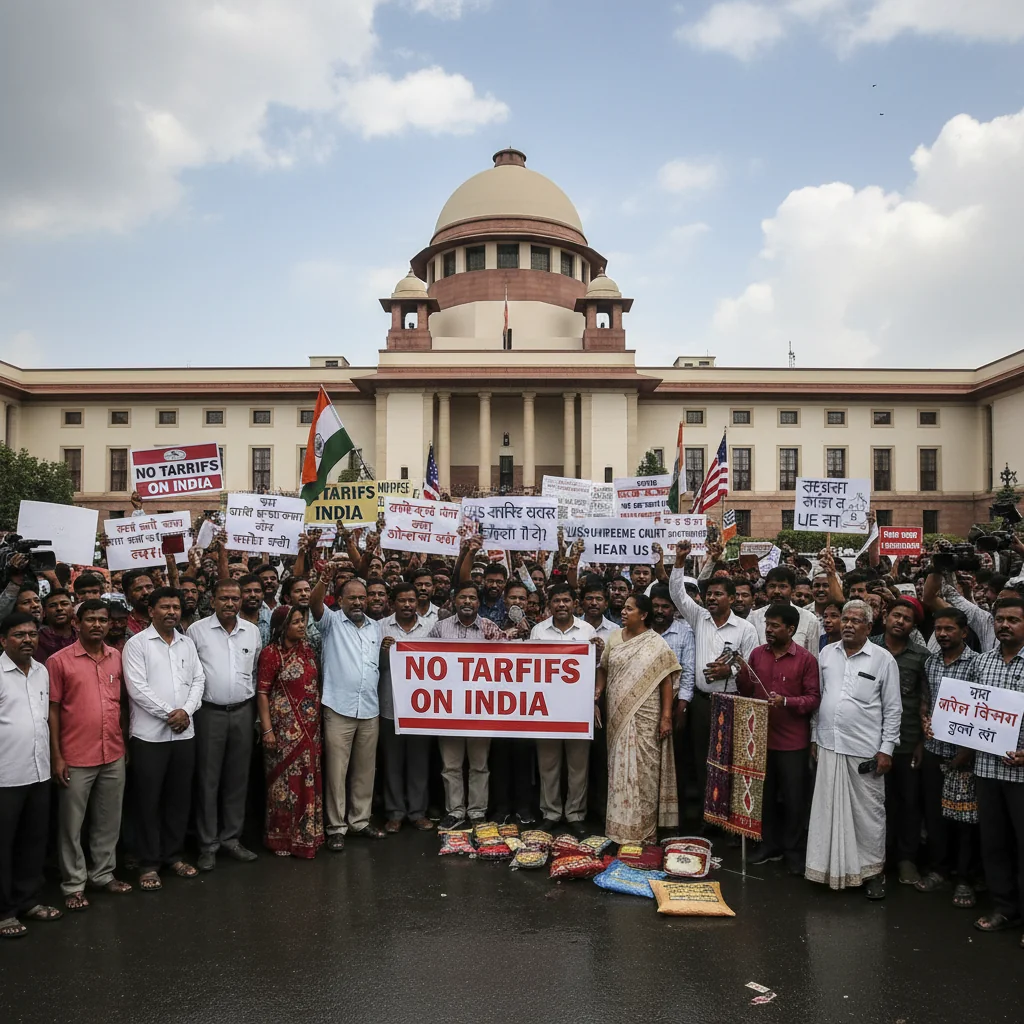
U.S. Supreme Court to Review Legality of Tariffs on Indian Imports
The United States Supreme Court is set to hear oral arguments on November 5, 2025, concerning the legality of tariffs imposed by former President Donald Trump on Indian imports. These tariffs, totaling 50%, consist of a 25% reciprocal tariff and an additional 25% levy linked to India’s purchase of Russian oil.
Background of the Tariffs
In August 2025, the Trump administration implemented a 25% reciprocal tariff on Indian goods, citing trade imbalances. Subsequently, an additional 25% tariff was imposed in response to India’s continued importation of Russian energy products, bringing the total duties to 50%.
Legal Challenges and Court Proceedings
These tariffs have faced legal challenges, with plaintiffs arguing that the administration exceeded its authority under the International Emergency Economic Powers Act (IEEPA). On August 29, 2025, the U.S. Court of Appeals for the Federal Circuit ruled 7-4 that the tariffs were unlawful, stating that the President had overstepped his authority under the IEEPA. The administration appealed this decision, leading to the upcoming Supreme Court hearing.
Implications for U.S.-India Trade Relations
The tariffs have significantly impacted U.S.-India trade relations. The World Bank projected that South Asia’s economic growth would slow to 5.8% in 2026, down from 6.6% in 2025, primarily due to these tariffs affecting approximately $50 billion worth of Indian exports. Sectors such as textiles, gems and jewelry, and shrimp have been particularly affected.
Statements from Key Figures
Former President Trump announced he would not attend the Supreme Court hearing to avoid becoming a distraction, emphasizing the national importance of the decision. Treasury Secretary Scott Bessent will represent the administration, highlighting the case as an “economic emergency.” The administration maintains that the tariffs are crucial for national security and to address trade imbalances.
The Supreme Court’s decision is anticipated to have far-reaching consequences for the scope of presidential power in trade policy and the future of U.S.-India economic relations.


